
Two ways to build a bonus round#
The comparison table sets out the figures. The interesting part is what sits behind them, because these two games solve the same design problem in opposite ways.
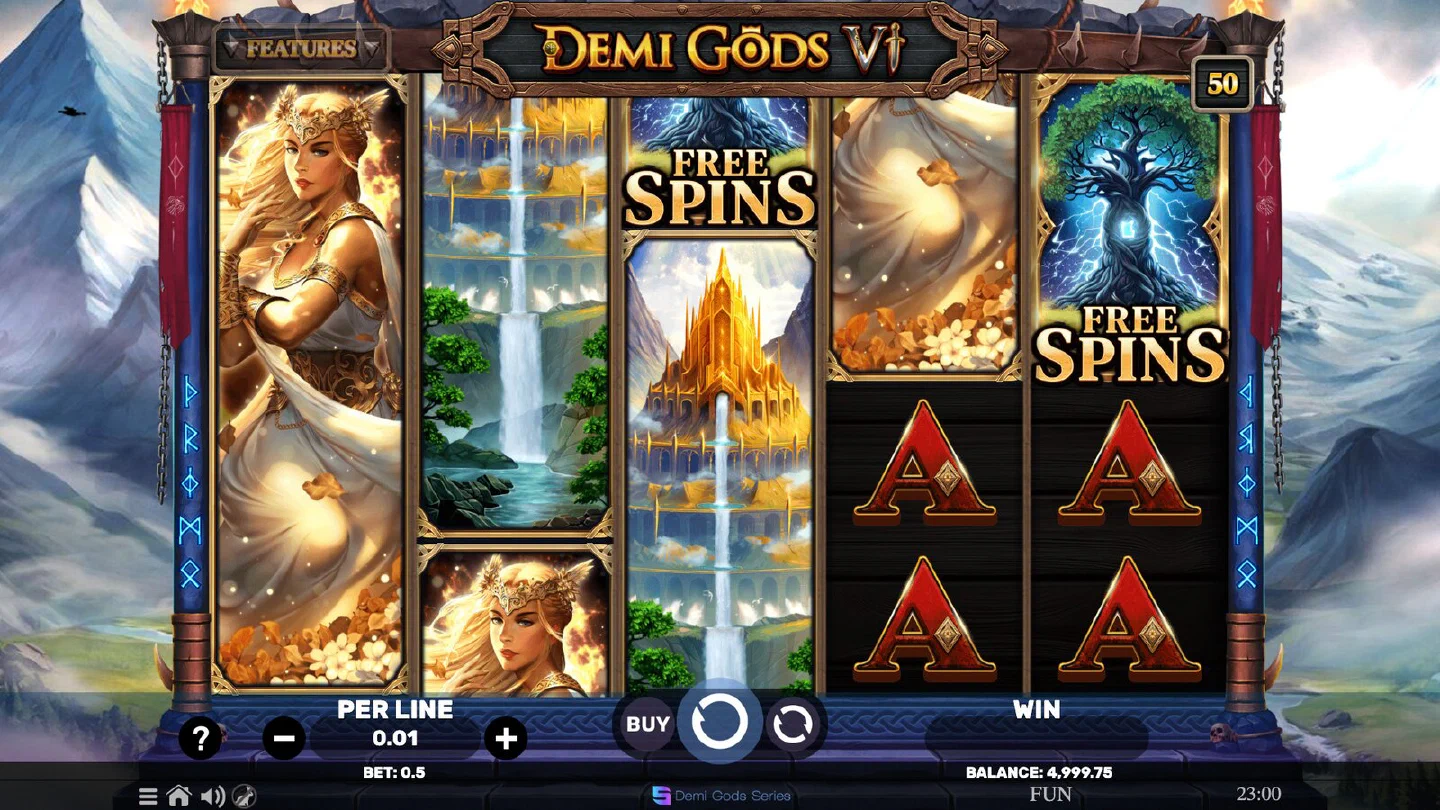
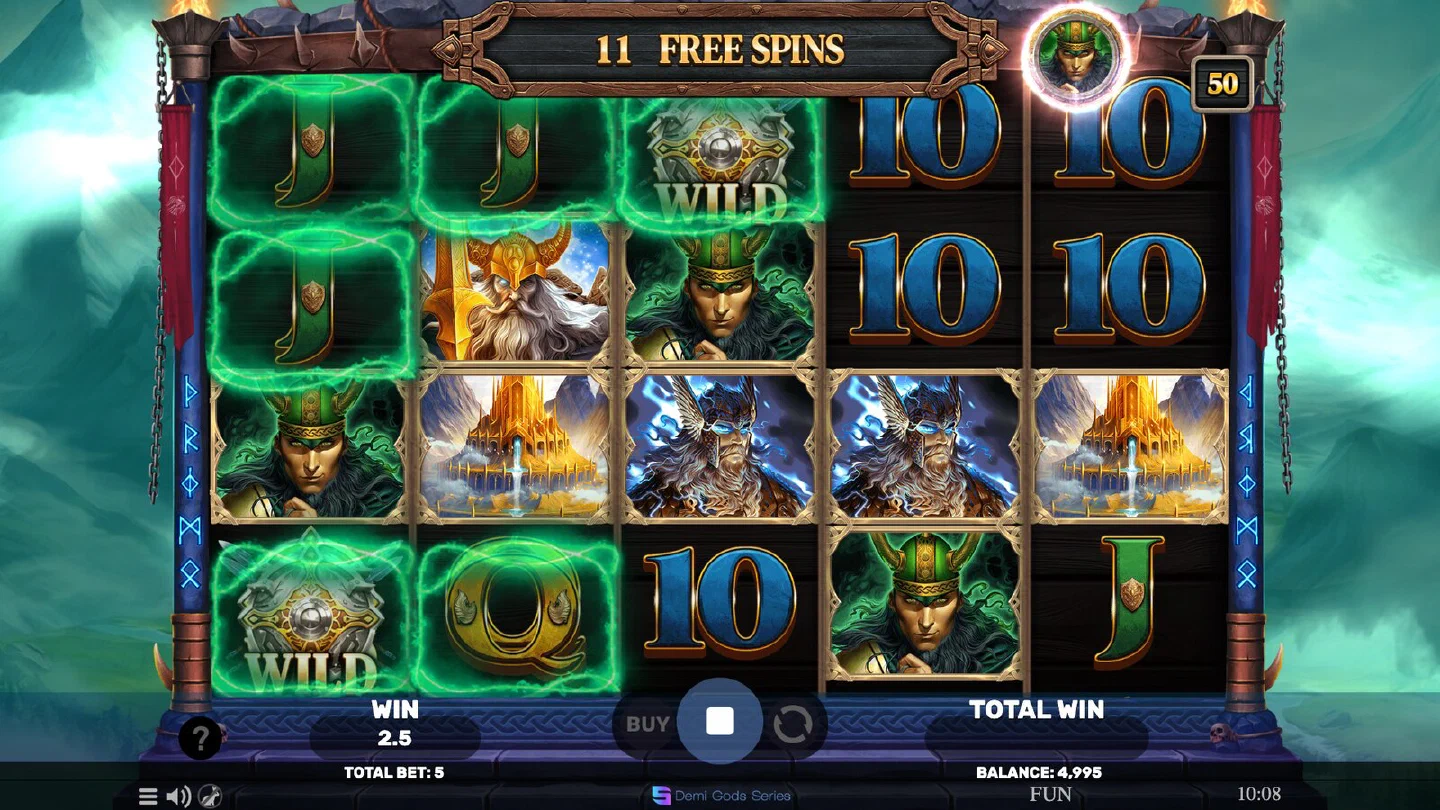
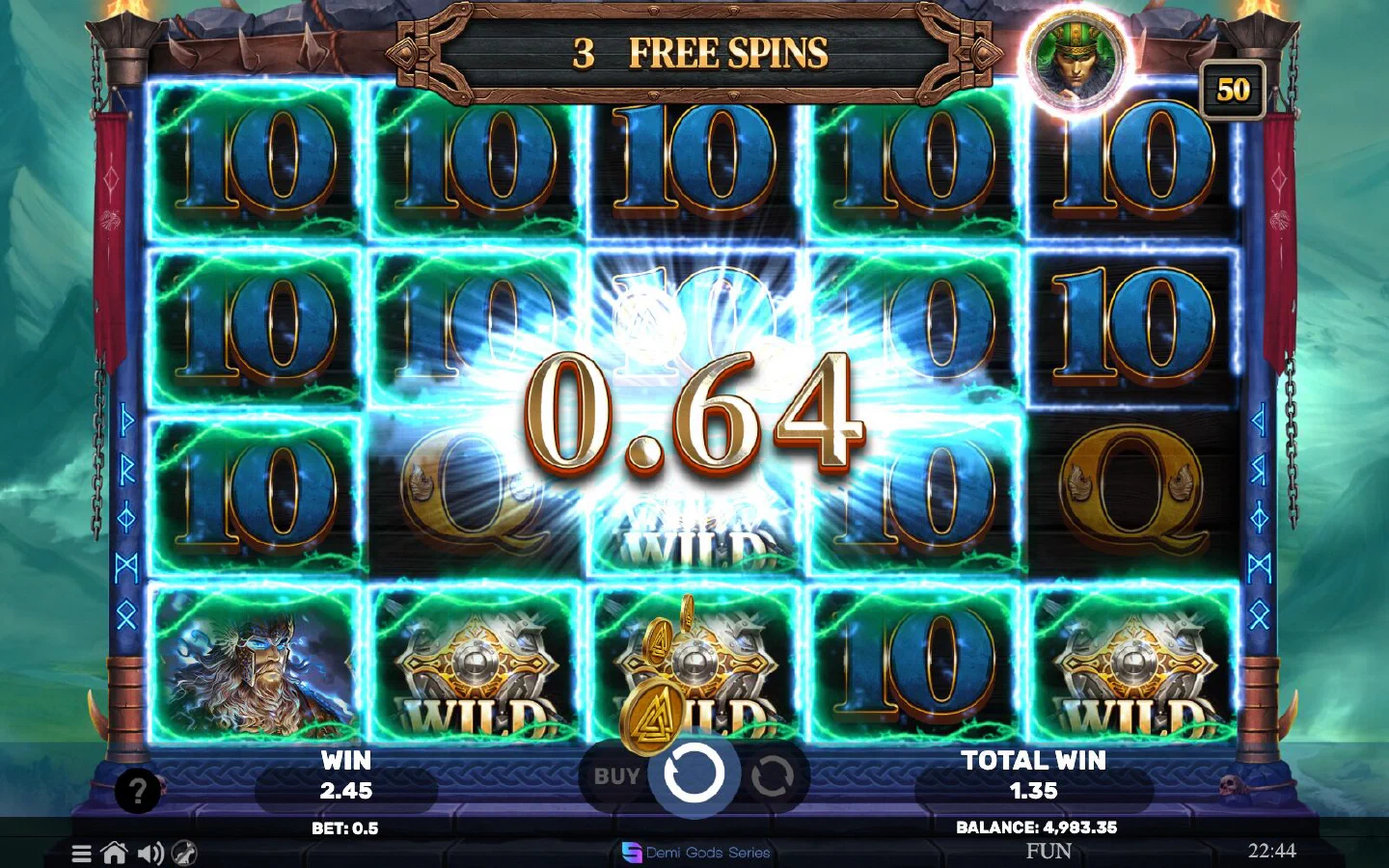
Demi Gods VI holds the board still and changes the rules. Fifty lines are fixed, the 5x4 grid never grows, and the bonus works by rewriting one rule of the respin at a time. Three or more full-sized free spins symbols open the round at LOKI, where winning symbols lock and the rest of the grid spins again. THOR seeds Extra Wilds across the reels, FREJA shifts them and respins, and ODIN closes the path with Stacked Wilds. The order never changes, and the client announces the next stage as each one ends. A round that triggers on the reels runs 10 or 11 spins; a bought round runs 12.
Raiders of the East does the reverse. Its base game runs on three rows, and collecting ship symbols eventually unlocks a fourth, converting the game into a 5x4 board with up to 1,024 ways that stays that way for the session. Its free games are a fixed award of 10, with collected keys adding spins and raising a global multiplier. Progress there is structural: the board you play on grows.
Neither approach is better in the abstract. One gives you a path with a visible next step, the other gives you a permanent upgrade to the machine. What they demand of a session differs, though, and that is where the choice actually lives.
Rhythm and ceiling: what feels different#
Volatility is the honest headline of the comparison: medium against high. That single difference explains most of what a player notices.
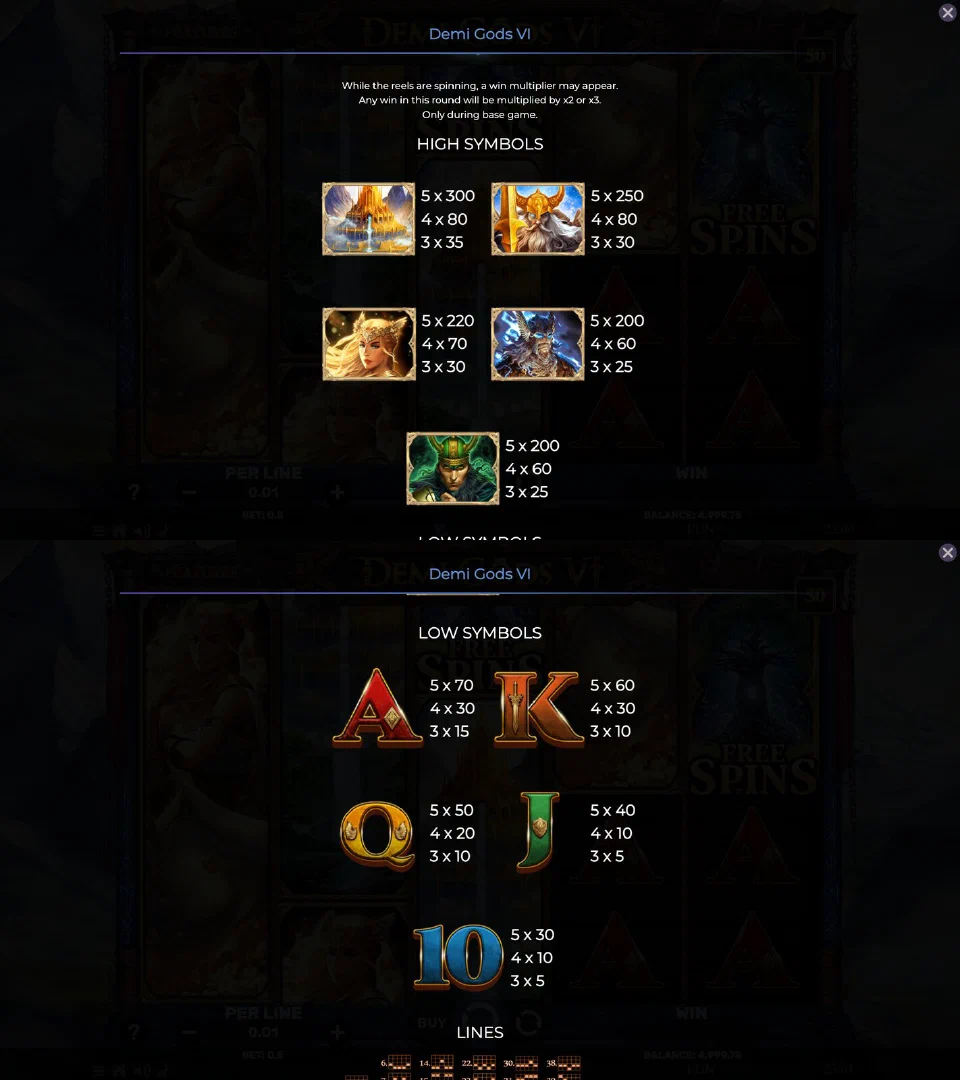
On the Demi Gods VI side, 50 fixed lines are live on every spin and three-symbol prizes start at 5x the bet per line, running up to 35x on Asgard. A random 2x or 3x can attach itself to any of them, so the big results here are assembled out of ordinary ones rather than dropped in from nowhere. The ceiling is 900x the stake: 450 at a 0.5 spin, 4,500 at 5, and 450,000 at the 500 maximum.
The rival trades that rhythm for reach. Its ceiling of 3,168x is exactly 3.52 times this one, and its high-variance rating is the price of it: longer quiet stretches, larger peaks. Put the two ceilings on the same stake and the difference stops being abstract: at a 0.5 spin, 450 here against 1,584 there. A game shaped like that wants either a longer bankroll at the same stake or a lower stake for the same budget.
The practical translation: if your evening has a fixed length and you want it filled, medium volatility on 50 lines is the more comfortable proposition. If you are playing for the shape of the top end, the higher ceiling is the reason to take the other seat. The RTP page works through the four Demi Gods VI builds and the maths behind that 900x figure.
Buying the round: price and what comes in the package#
Both games sell their bonus, and the two offers are shaped differently enough to be worth a table of their own.
| Total bet on Demi Gods VI | Cost of the buy | What you receive |
|---|---|---|
| 0.5 | 18 | 12 free spins, Winning Symbols Respin |
| 5 | 180 | 12 free spins, Winning Symbols Respin |
| 50 | 1,800 | 12 free spins, Winning Symbols Respin |
| 500 | 18,000 | 12 free spins, Winning Symbols Respin |
One price, at every rung: 36x the total bet, which is by definition the cost of 36 ordinary spins at whatever stake you are on. The rival asks more in multiplier terms, 45x the base bet, rising to 55x once its extra row is unlocked, and gives 10 Free Games in exchange.
Two honest notes about that comparison. First, the packages differ: 12 spins of a respin mode is not the same product as 10 free games with a key-collection multiplier, so the prices are not strictly like for like. Second, and more important, a buy price is a price in both games. It says what the round costs, not how often it would have arrived on its own, and on Demi Gods VI the free path stays open the whole time you spin: three free spins symbols in the base game open the same mode for nothing.
If the flat 36x is the thing you like about this side of the comparison, the strategy page turns it into a session plan with the arithmetic done.
Reading the RTP rows without fooling yourself#
The table shows four published builds on one side and three on the other, and the top figures are close: 95.74% against 96.30%. It would be easy to declare the rival ahead by half a point and move on. That reading is wrong in both directions.
On the Demi Gods VI side, the four builds run from 88.83% to 95.74%, and the casino decides which one it integrated. So the relevant question is not what the best build returns but what the build in front of you returns, and since the client prints no percentage of its own, the casino’s own page for the game is where that is written. A table running 92.02% is a materially different proposition from one running 95.74%, with identical reels.
The rival has the same structure with a narrower spread, three builds from 92.24% to 96.30%, and the same dependence on the operator’s choice. Comparing the two headline numbers therefore compares two best cases, and a best case is only one of four settings on this side and one of three on the other.
The practical instruction is the same for both games: read the build off the casino’s own game page when you sit down, prefer the higher one when you have a choice, and treat any single published figure you read elsewhere as a description of one table rather than of a title. The Demi Gods VI maths page works through all four builds and what each one changes.
What each game demands of a budget#
Volatility is easiest to understand as a demand rather than as a property. A high-variance game asks for either more spins or a lower stake to show you what it does; a medium one asks for less.
Demi Gods VI, at medium, runs on 50 fixed lines with three-symbol prizes from 5x the bet per line. A budget of 500 units of stake at the 0.5 minimum buys 1,000 spins, and at the rival’s 0.10 minimum the same budget buys 5,000. Those two numbers, not the ceilings, are what actually decide how much of either game you get to see.
The rival, at high volatility with a 3,168x ceiling and a minimum of 0.10 a spin, asks for patience in exchange for reach. Its shape rewards a longer run at a smaller stake, and its structural upgrade, the fourth row unlocked for the rest of the session, is itself a reason to stay rather than to dip in.
So the budget question splits cleanly. If your evening is fixed in length and you want it filled with results, the medium game is the better fit. If you are content with quiet stretches in exchange for a bigger top end, the high-variance design is doing exactly what it advertises.
The same money, spent on either#
Take 500 units of stake and put it through both games at their minimums, and the shape of the two evenings separates before a single feature does.
| Demi Gods VI | Raiders of the East | |
|---|---|---|
| Minimum spin | 0.5 | 0.10 |
| Spins from a budget of 500 | 1,000 | 5,000 |
| Ceiling of one round at that minimum | 450 | 316.8 |
| Volatility | Medium | High |
The rival’s lower minimum buys five times as many spins, which is exactly what a high-variance design asks for. Demi Gods VI asks for less patience and gives back a steadier rhythm: 50 lines live on every one of those 1,000 spins, three-symbol prizes from 5x to 35x the bet per line, and a random 2x or 3x that can land on any of them. Neither column is the better deal; they are two different ways to spend the same money.
Where the two games genuinely overlap#
It is worth listing the common ground, because a comparison that only finds differences is usually overstating them.
Both are five-reel, character-led adventures, Norse gods on one side and a shogun’s Japan on the other, with a wild that does more than substitute. Both award free spins in a fixed count rather than an open-ended run, 12 from a bought round here and 10 there. Both let you skip the wait by paying for the round, and both price that purchase as a multiple of your stake rather than as a flat amount, so the decision scales with how you play. Both publish more than one RTP build and leave the choice to the operator. And both run on modern clients that open in a browser on a phone without an install.
What that overlap means practically: if you enjoy one, the other is a reasonable next stop rather than an alien experience. The differences are in temperament rather than in genre, which is why the verdict block frames this as two jobs rather than two grades.
One caveat on the release dates in the table, since they sit almost two years apart, 29 October 2024 against 26 August 2026. A newer game is not automatically a better one, and an older one is not automatically settled. Judge them on the rows above instead: medium against high, 900x against 3,168x, 50 fixed lines against up to 1,024 ways, 36x of the total bet against 45x or 55x of the base bet.
If you would rather stay with one#
If you arrived with a preference and wanted it checked, here it is plainly. If you like watching a path advance, and you want a 50-line game with a readable paytable and a buy you do not have to think about, Demi Gods VI is the one, and it is one click away. If you want a high-variance game that physically expands its own board and reaches past 3,000x, the rival is built for exactly that, and taking it is the right call.
What you should not do is mix their numbers. They come from different studios, different maths and different years, and the only place they meet is a table like the one above. The review argues the Demi Gods VI case on its own terms, the main game page has the full card, and the features page covers what each of the four modes does on the reels.