
The maths of Demi Gods VI, step by step
Four builds, one ceiling, one stake ladder and one buy price, each worked out at the bottom, the middle and the top of the range.
Four RTP builds and what they mean for you#
Return to player (RTP) is the first number anyone looks up for this slot, and it is the one place where Demi Gods VI asks you to do a minute of homework. Spinomenal publishes the game in four builds: 88.83%, 92.02%, 93.31% and 95.74%. A casino integrates one of them, the client prints no percentage on screen, and so the figure you play is a property of the table rather than of the title. The reading that stays true everywhere is up to 95.74%, depending on the build the table runs.
That also explains the numbers floating around elsewhere. A flat 96.00% appears on one British operator’s own game card, and it matches none of the four published configurations. Stick to the set below and you will always be right:
| Build | RTP | What changes for you |
|---|---|---|
| 1 | 95.74% | The top of the set. Worth confirming on the casino’s own game page before a longer session. |
| 2 | 93.31% | Same reels, same paytable, a leaner long-run return. |
| 3 | 92.02% | A step further down, with the paytable and the 36x buy price unchanged above it. |
| 4 | 88.83% | The floor of the published range. The game plays identically; the return does not. |
Nothing else about the slot moves between builds. The grid stays 5x4, the lines stay at 50, the paytable stays where it is and the buy keeps its price. Only the long-run return shifts, and since the client prints no percentage of its own, the place that answers the question is the casino’s own page for the game: thirty seconds in the lobby, once per table.
Medium volatility: how the rhythm feels#
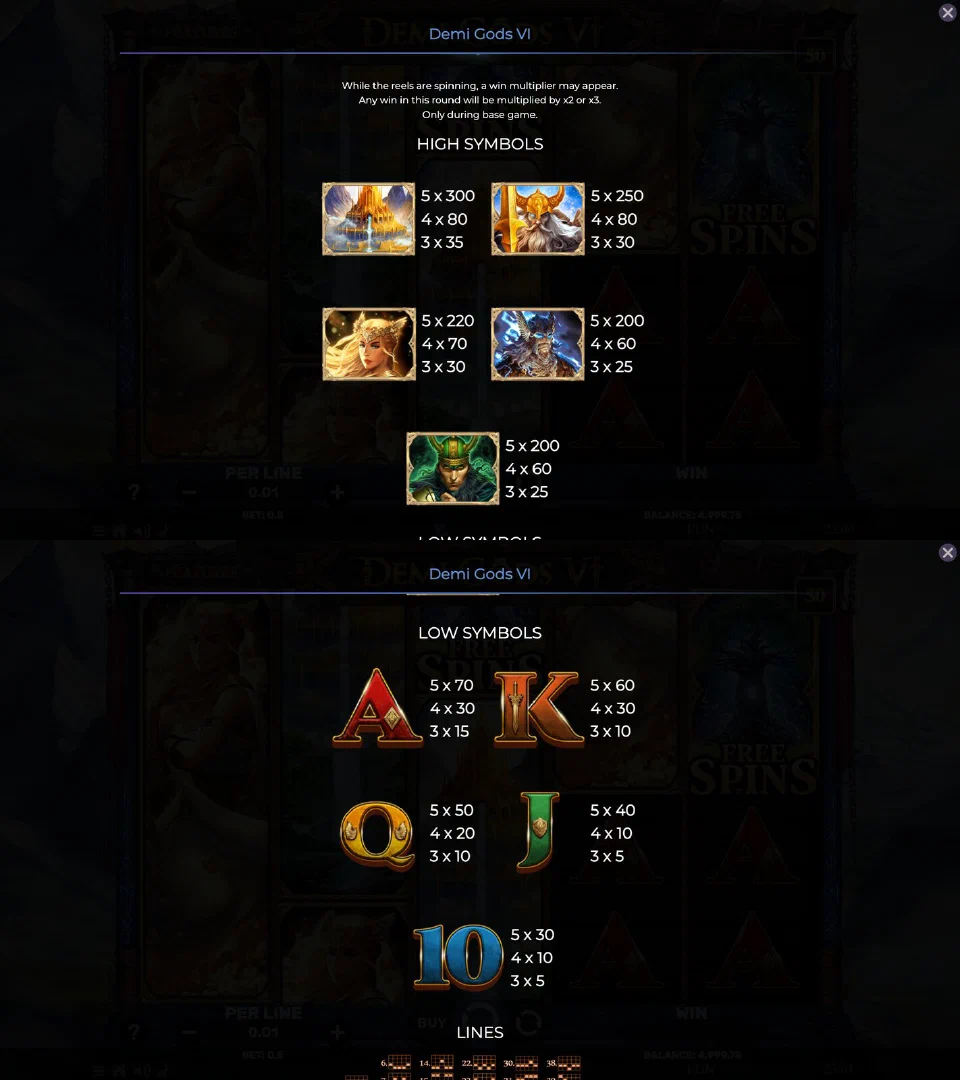
Spinomenal rates the game medium, and the paytable shows why. Fifty fixed lines are live on every spin, and three-symbol prizes run from 5x the bet per line on the ten and the J up to 35x on Asgard. Those are the results that carry a session: frequent enough to keep contact with the grid, small enough that the round is not decided by them.
Four-symbol prizes are the next tier up, from 10x on the low end to 80x on Asgard and Heimdall, and five on a line runs from 30x to 300x. Put that on a real stake and it stops being abstract. At 0.01 per line, four A symbols pay 0.3 and five Asgard pay 3. At 10 per line the same two results are 300 and 3,000.
Then the base-game multiplier redraws all of it. A random 2x or 3x can attach to any win in the base game, so a 35x three-of-a-kind on Asgard is doubled or tripled without any change to the stake. Read against the tiers above, that is what a medium rating buys: the distance between a routine result and a good one is a coin-flip of the multiplier rather than a jump to a different part of the table. The strategy page turns that into a way to plan a session rather than a run of numbers.
The stake ladder: from 0.5 to 500#
You never set the total directly. The control moves the bet per line, and the game multiplies by 50 because every line is fixed on. Four rungs cover the whole range:
| Bet per line | Total per spin | Five Asgard on a line (300x the line bet) | A 900x round (900x the total) |
|---|---|---|---|
| 0.01 | 0.5 | 3 | 450 |
| 0.1 | 5 | 30 | 4,500 |
| 1 | 50 | 300 | 45,000 |
| 10 | 500 | 3,000 | 450,000 |
The top rung is not theoretical: 10 per line is a 500 spin, and the control goes there. The bottom rung is just as real, and it is the one most sessions should start on, because the shape of the game is the same at both ends. A 50-line grid, a medium rating and a random multiplier behave identically whether the spin costs 0.5 or 500. Only the arithmetic changes.
One consequence worth naming: because prizes are quoted per line, the same headline number means very different things at different rungs. A 300x symbol line is 3 at the bottom and 3,000 at the top. The how-to-play page shows where that control sits and how autoplay handles it.
Buying the round: 36x at every step#
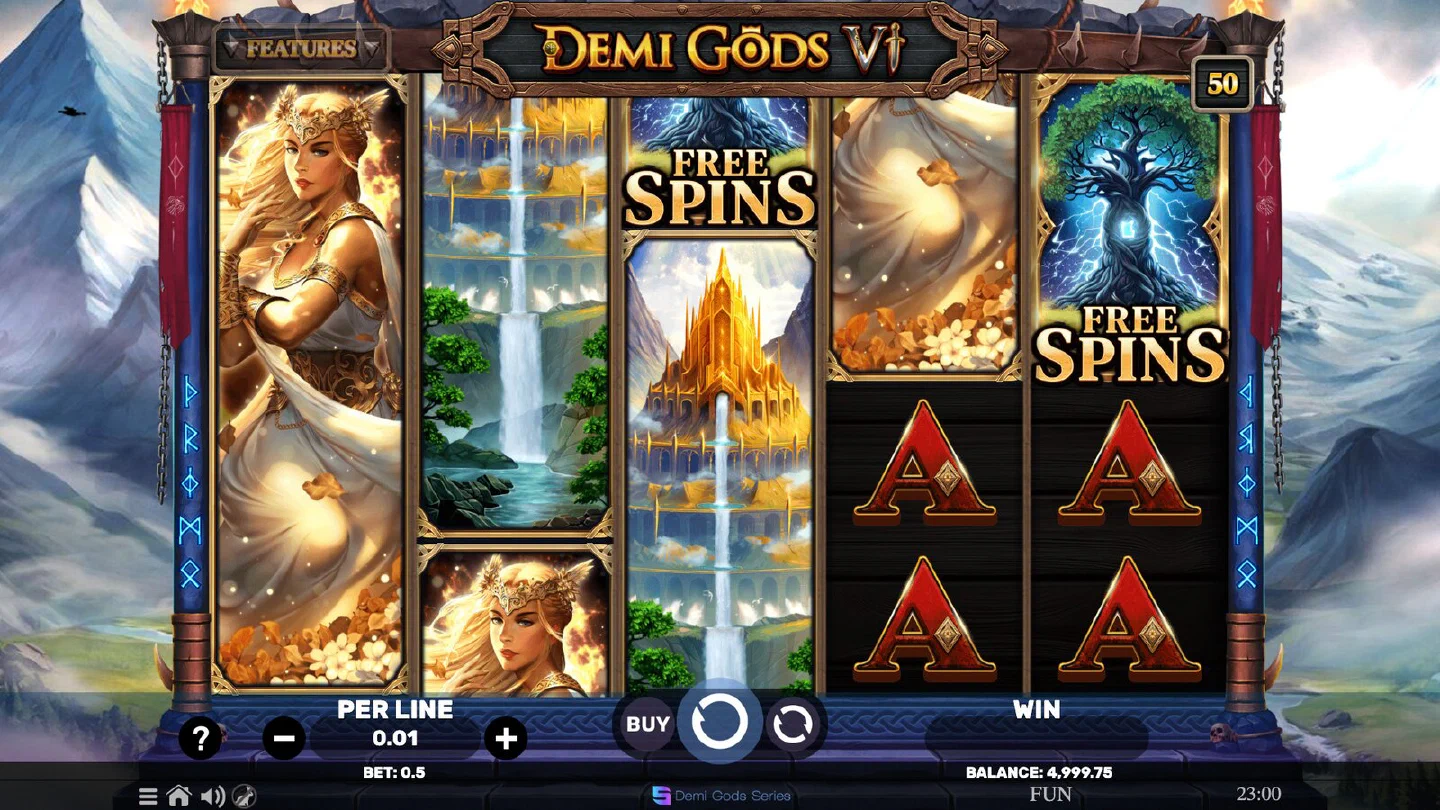
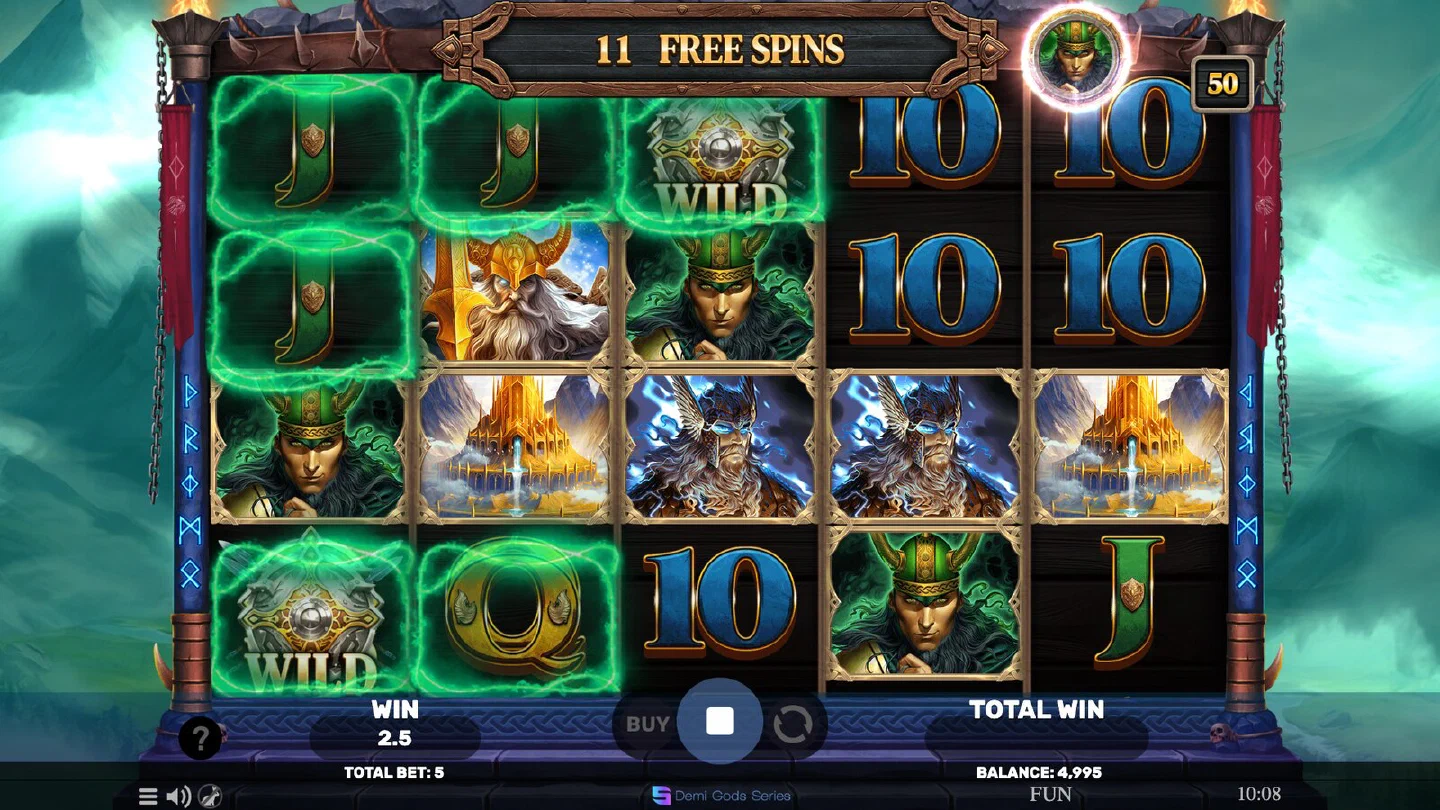
The BUY button sits under the base-game grid and asks one price. It is 36x the total bet, with no tier menu and no second option, and it awards 12 free spins in the Winning Symbols Respin mode, the first stage of the Free Spins Journey.
| Total bet | Cost of the buy | Equivalent in base spins | What lands |
|---|---|---|---|
| 0.5 | 18 | 36 spins | 12 free spins, LOKI stage |
| 5 | 180 | 36 spins | 12 free spins, LOKI stage |
| 50 | 1,800 | 36 spins | 12 free spins, LOKI stage |
| 500 | 18,000 | 36 spins | 12 free spins, LOKI stage |
The fourth column is the honest way to read the third. A price of 36x means the buy costs what 36 ordinary spins cost at your current stake. It is a price and nothing more: it does not say how often the round would have arrived on its own, and the same mode reaches you free whenever three free spins symbols land in the base game. Where your table shows the BUY button, that price is the same 36x.
The ceiling: what a 900x round is worth#
Spinomenal states the maximum as a multiplier of the stake rather than as a capped amount: 900x on a round. This is the figure for the base edition of Demi Gods VI, the one running under the code SlotMachine_DemiGodsVI on a 5x4 grid with 50 lines. The other titles sharing the name, including Demi Gods VI: Hold & Hit and Demi Gods VI - Mystic Shadows, carry their own maths and their own ceilings, and their numbers should never be borrowed for this one.
Priced out, 900x is 450 at the 0.5 minimum, 4,500 at 5, 45,000 at 50 and 450,000 at the 500 maximum. Note what the figure attaches to: a round, not a session and not a spin sequence. The path to the top of it runs through the Free Spins Journey, with Stacked Wilds Respin under ODIN as the heaviest of the four modes, and the base-game multiplier adding its 2x or 3x along the way. That is where the potential of this game lives; there is a clean answer here rather than a progressive pool to chase.
The paytable as a distribution#
One more way to read the maths, and the most useful one if you like numbers. The paytable reads less like a prize list and more like a description of how the game spreads its return across outcomes, and the spread here is unusually even.
| Tier | Range across the symbol set | What it does for the session |
|---|---|---|
| Three on a line | 5x to 35x the bet per line | The backbone: frequent, modest, and multiplied by the 50 lines running at once |
| Four on a line | 10x to 80x the bet per line | The step up that a random 2x or 3x turns into a real result |
| Five on a line | 30x to 300x the bet per line | The tier the respin modes exist to manufacture |
Look at how far the cheapest symbol sits from the dearest at each tier. Three on a line: 5x on the ten and the jack against 35x on Asgard, a factor of seven. Four on a line: 10x against 80x, a factor of eight. Five on a line: 30x against 300x, a factor of ten. The gap widens as you climb, but gently, from seven to ten rather than from seven to fifty, and that gentle widening is what a medium volatility rating looks like when you write it out in numbers. On a high-variance design the top tier would be several times further away from the bottom one than it is here.
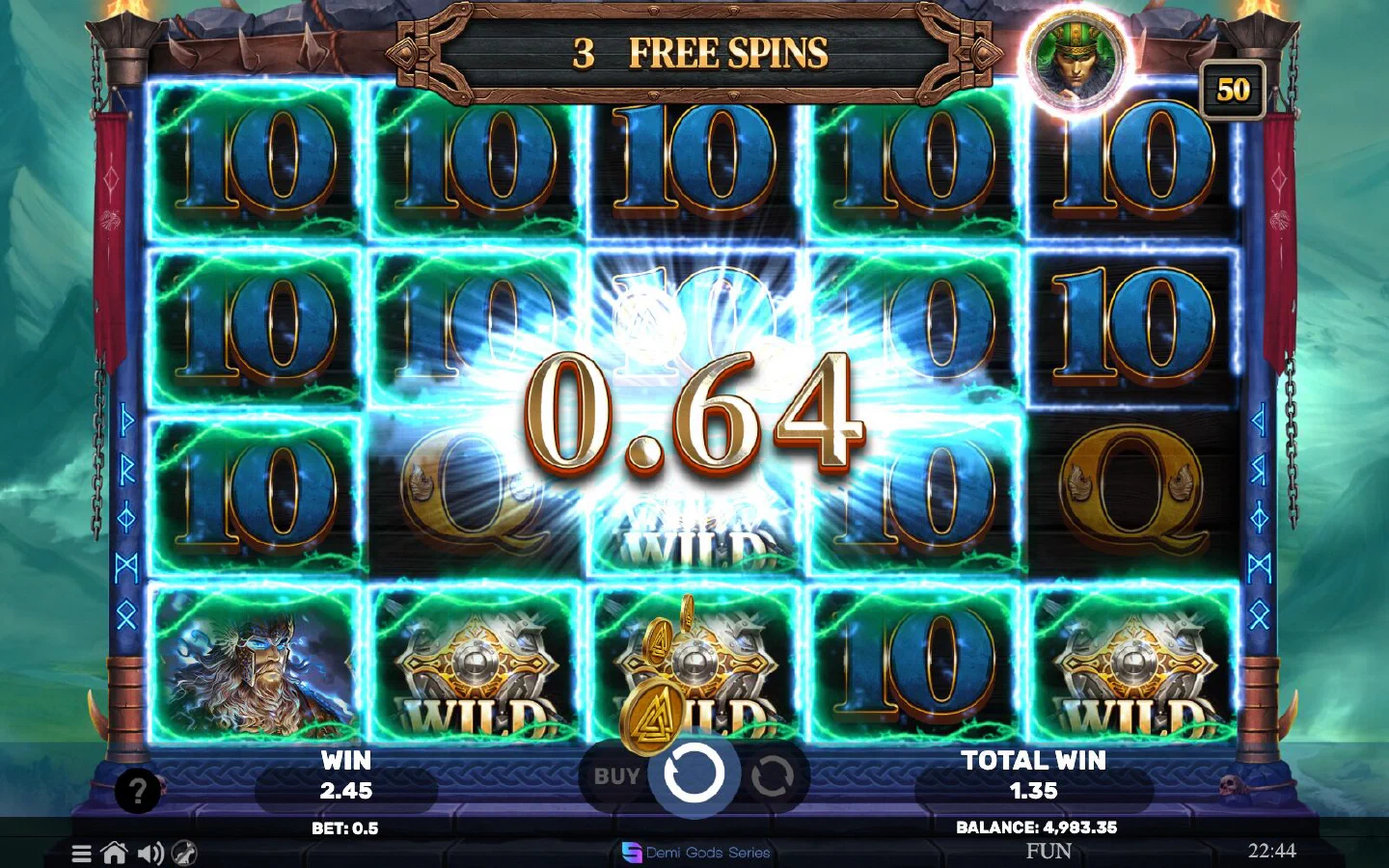
The wild does the rest of the work. Five wilds on a line pay 300x the bet per line, matching Asgard, and as a substitute the shield converts near misses into paid lines across all 50 of them. During the Extra Wilds stage the reels carry more of them, which is why that mode changes the shape of a round rather than just its length. The features page covers each stage on the reels.
Reading these numbers honestly#
RTP is a property of the game measured across millions of rounds, not a forecast for your afternoon. A 95.74% build does not owe you 95.74% of anything tonight, and a medium volatility rating describes a distribution rather than a schedule. The useful things it does tell you are relative: which table to prefer when you have a choice, how far apart the low and high tiers of the paytable sit, and what the buy costs compared with simply spinning.
The same goes for the 900x ceiling. It is the shape of the top end, and the honest planning tool is the stake ladder above: pick a rung you are comfortable repeating, then decide how many spins you want the session to last. The main game page carries the full card, the features page explains what each of the four modes actually does, the comparison with Raiders of the East sets these numbers against another slot of the same class, and the demo lets you test all of it on play credits first.

18+. RTP describes long-run behaviour and never forecasts a session. Set your limit before the first spin: responsible gambling .